

FUT Hair Transplant in Noida: The Power of Maximum Graft Restoration
For individuals experiencing significant hair loss and seeking the most substantial density in a single session, the Follicular Unit Transplantation (FUT) method remains a powerful and highly effective solution. At RenewU, our board-certified surgeons are masters of this classic and dependable technique. Also known as the “strip method,” the FUT procedure allows for the transplantation of a large number of hair grafts in one sitting, making it an excellent choice for achieving dramatic and transformative results in cases of advanced hair loss.
What is FUT? The “Strip Method” Procedure Explained
Follicular Unit Transplantation (FUT) is a surgical hair restoration technique where hair follicles are harvested from the donor area in a single, continuous group.
The procedure involves the surgical removal of a thin, linear strip of tissue from the donor area (the back and sides of the scalp), where the hair is genetically programmed to be permanent. This donor strip, rich in healthy hair follicles, is then handed to a highly skilled technical team who use high-powered stereoscopic microscopes to meticulously dissect it into thousands of individual follicular units (natural groupings of 1-4 hairs). While the grafts are being prepared, the surgeon closes the donor area with fine sutures, a technique designed to result in a very fine, easily concealable linear scar.
Finally, these perfectly dissected grafts are artistically implanted into the recipient (balding) area, following the natural angle and pattern of your hair growth.
The RenewU Advantage: Why Consider an FUT Transplant?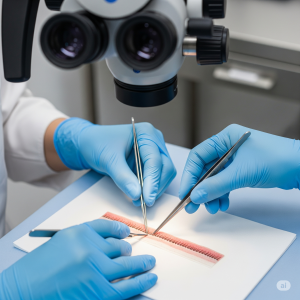
While FUE is known for its “no linear scar” benefit, FUT offers its own distinct and powerful advantages.
Maximum Graft Yield: The primary benefit of FUT is the ability to harvest a large number of high-quality grafts—often 3000 or more—in a single, efficient session. This makes it an ideal choice for covering large areas of baldness.
High Graft Survival Rate: The microscopic dissection of the donor strip by an expert team ensures that the follicular units are kept in their natural, intact state, leading to an exceptionally high survival and growth rate for the transplanted hairs.
Preservation of Donor Area: Because the hair is harvested from one consolidated area, the surrounding donor hair remains untouched, preserving it for any potential future procedures.
Often a Shorter Procedure Time: For large sessions, the harvesting process in FUT can be quicker than extracting thousands of individual grafts one by one with FUE.
Is FUT the Right Procedure for You?
FUT is an excellent and often preferred option for individuals who:
Are experiencing a more advanced stage of hair loss and require a large number of grafts to achieve their desired density.
Prefer to keep their hair longer at the back and sides, as this will easily conceal the fine linear scar.
Have good scalp laxity (flexibility), which allows for the easy removal and closure of the donor strip.
Are looking for the most efficient way to achieve maximum density in a single surgical session.
FAQ
Q: Will I have a noticeable scar after an FUT procedure? The FUT procedure results in a single, fine linear scar in the donor area. Our surgeons are experts in the Trichophytic Closure technique, a specialized suturing method that allows hair to grow through the scar, making it extremely difficult to detect, even with relatively short hair.
Q: How does FUT recovery compare to FUE? The initial recovery for FUT is slightly longer due to the linear incision. There may be more initial tightness or soreness in the donor area, and the sutures are typically removed after about 10-14 days. However, the recovery in the recipient area is identical to FUE.
Q: Are the results as natural as FUE? Absolutely. The naturalness of a hair transplant is determined by the implantation of the grafts, not the extraction method. The artistic skill of the surgeon in designing the hairline and placing the grafts is what creates a natural result. The grafts used in both FUT and FUE are identical follicular units.
Q: Can I have an FUE procedure after having an FUT? Yes. In fact, combining the methods is a common long-term strategy. A client might have an FUT procedure for maximum coverage initially and then use FUE for smaller, subsequent sessions if needed, completely avoiding any further scarring in the donor area.